
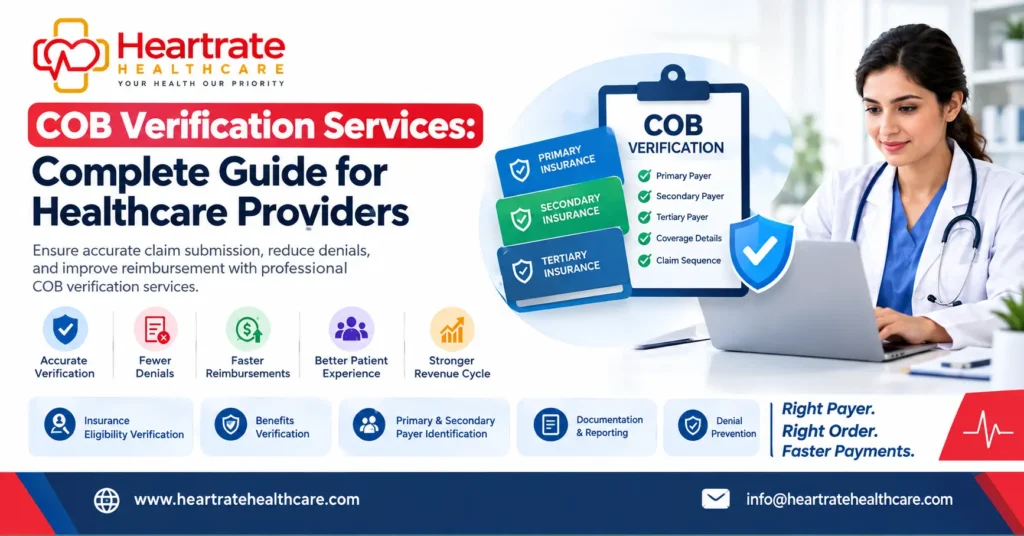

COB Verification Services: Complete Guide for Healthcare Providers
In today's healthcare revenue cycle, COB Verification Services play a critical role in ensuring accurate claim submission and timely reimbursements. Coordination of Benefits (COB) verification helps healthcare providers determine which insurance plan is responsible for paying first when a patient has multiple insurance coverages. Accurate COB verification reduces claim denials, minimizes payment delays, and improves overall revenue cycle performance. Healthcare organizations increasingly rely on professional verification services to identify primary and secondary payers before claims are submitted. Proper COB verification improves billing accuracy, patient satisfaction, and financial outcomes for medical practices.
What Are COB Verification Services?
COB Verification Services involve verifying a patient's insurance coverage when multiple health insurance plans exist. The process determines:
- Primary Insurance Carrier
- Secondary Insurance Carrier
- Tertiary Coverage (if applicable)
- Coverage Effective Dates
- Policy Status
- Benefits Coordination Rules
- Claim Submission Sequence
The goal is to ensure claims are billed to the correct payer in the proper order, preventing claim denials and payment delays. Healthcare organizations use COB verification to avoid costly billing errors and improve reimbursement rates.
Why COB Verification Is Important
Many claim denials occur because insurance plans are billed in the wrong order. When healthcare providers fail to verify insurance coordination properly, claims can be rejected or delayed.
Benefits include:
- Reduced claim denials
- Faster reimbursements
- Improved cash flow
- Enhanced patient experience
- Lower administrative burden
- Better compliance
- Increased first-pass claim acceptance
Healthcare providers that implement effective COB Verification Services experience improved revenue cycle efficiency and fewer billing complications.
Common COB Scenarios
1. Employee and Spouse Coverage
A patient may have insurance through their employer and also be covered under a spouse's plan.
2. Medicare and Commercial Insurance
Patients eligible for Medicare may also have employer-sponsored insurance.
3. Dependent Children
When children are covered under both parents' insurance plans, specific coordination rules determine the primary payer.
4. Dual Eligibility
Patients may qualify for both Medicare and Medicaid benefits.
5. Multiple Commercial Plans
Patients can sometimes have more than one commercial insurance policy.
These situations require accurate COB verification to ensure proper claim submission.
How COB Verification Services Work
Step 1: Patient Information Collection
Gather:
- Insurance cards
- Policy numbers
- Subscriber information
- Coverage details
Step 2: Insurance Verification
Verify active insurance coverage with all listed payers.
Step 3: Benefits Analysis
Review:
- Deductibles
- Copays
- Coinsurance
- Coverage limitations
Step 4: Determine Payer Order
Identify:
- Primary payer
- Secondary payer
- Tertiary payer
Step 5: Documentation
Update EHR and billing systems with verified COB information.
Step 6: Claim Submission
Submit claims in the correct order according to payer requirements.
Key Components of COB Verification Services
Insurance Eligibility Verification
Ensures active insurance coverage before services are rendered.
Benefits Verification
Confirms coverage details and patient responsibilities.
Primary and Secondary Payer Identification
Determines claim submission order.
Medicare Secondary Payer Verification
Ensures compliance with Medicare coordination rules.
Documentation and Reporting
Maintains accurate records for future billing activities.
Denial Prevention
Reduces errors before claims are submitted.
Challenges in COB Verification
Healthcare providers often face:
- Incomplete patient information
- Multiple insurance plans
- Frequent coverage changes
- Complex Medicare rules
- Manual verification delays
- Data entry errors
Professional COB Verification Services help overcome these challenges through specialized expertise and technology-driven processes.
How Heartrate Healthcare (HRHC) Supports COB Verification
Heartrate Healthcare (HRHC) provides healthcare support solutions that help medical organizations streamline insurance verification and revenue cycle management processes.
Benefits include:
- Accurate insurance verification
- Reduced claim denials
- Faster payment cycles
- Revenue cycle optimization
- Dedicated support teams
- HIPAA-compliant processes
HRHC focuses on helping healthcare providers improve operational efficiency and financial performance.
Best Practices for COB Verification
Verify Before Every Visit
Insurance information changes frequently.
Maintain Accurate Records
Keep payer details updated.
Train Staff Regularly
Ensure billing teams understand coordination rules.
Use Technology
Leverage automation and verification tools.
Monitor Denial Trends
Identify recurring COB-related issues.
Conduct Audits
Review verification accuracy regularly.
Future of COB Verification Services
Emerging technologies are transforming insurance verification:
- Artificial Intelligence
- Automation
- Real-Time Eligibility Checks
- Electronic Data Interchange (EDI)
- Predictive Analytics
- API-Based Verification
These innovations improve verification speed, accuracy, and operational efficiency.
Conclusion
COB Verification Services are essential for healthcare organizations seeking to reduce claim denials, improve reimbursement accuracy, and strengthen revenue cycle management. Proper coordination of benefits ensures claims are billed correctly and payments are received faster. By implementing effective verification processes and partnering with experienced healthcare support providers such as Heartrate Healthcare (HRHC), organizations can optimize financial performance while enhancing patient satisfaction.
20 FAQs About COB Verification Services
1. What are COB Verification Services?
They verify insurance coordination and determine payer responsibility.
2. What does COB stand for?
Coordination of Benefits.
3. Why is COB verification important?
It reduces claim denials and payment delays.
4. Who needs COB verification?
Healthcare providers, hospitals, and medical billing companies.
5. What is a primary payer?
The insurance company that pays first.
6. What is a secondary payer?
The insurer that pays after the primary payer.
7. Can a patient have multiple insurance plans?
Yes.
8. How often should COB be verified?
Before every patient visit.
9. What causes COB claim denials?
Incorrect payer sequencing.
10. Does Medicare require COB verification?
Yes.
11. Can COB affect reimbursement speed?
Yes.
12. Is COB verification part of revenue cycle management?
Yes.
13. Does COB verification reduce denials?
Yes.
14. What information is needed for COB verification?
Insurance details and subscriber information.
15. Can software automate COB verification?
Yes.
16. Is COB verification HIPAA compliant?
It should be.
17. How does COB verification improve cash flow?
By preventing claim rejections.
18. What is tertiary insurance?
A third insurance payer.
19. What industries use COB verification?
Healthcare and medical billing.
20. Can outsourced providers perform COB verification?
Yes.