
Healthcare has become increasingly dependent on digital technology. From electronic health records and telemedicine to secure data exchange, cloud platforms, analytics, and connected devices, technology now supports many of the activities that healthcare organizations perform every day. This growing dependence has made Healthcare IT an important part of modern healthcare operations.
For hospitals, physician practices, clinics, laboratories, medical billing organizations, and healthcare businesses, effective technology is not simply about purchasing software. It involves selecting appropriate systems, integrating platforms, protecting sensitive information, supporting users, maintaining infrastructure, and ensuring that technology contributes to efficient patient and business workflows.
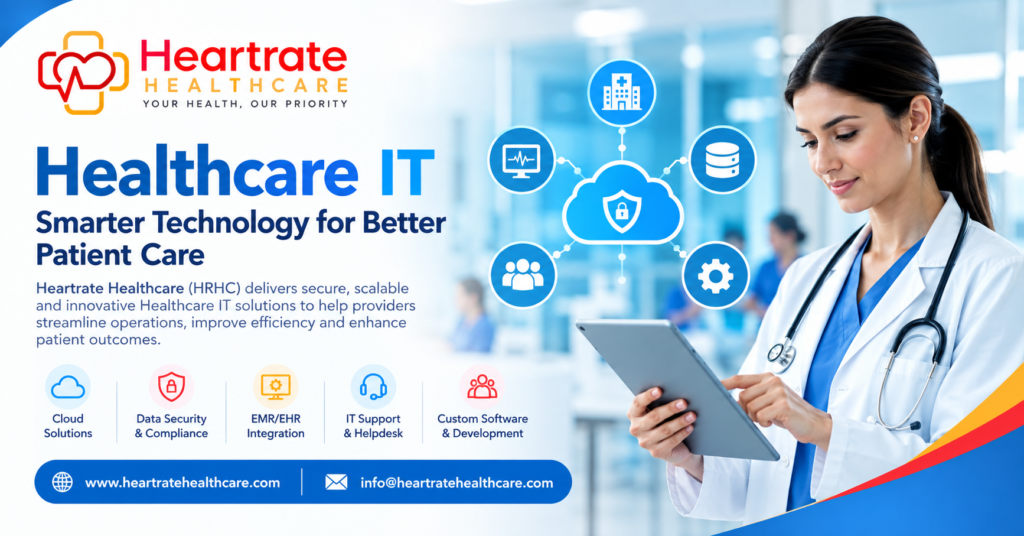
Heartrate Healthcare (HRHC) provides healthcare-focused technology and business support designed around these operational needs. By combining healthcare knowledge with technical capabilities, organizations can create more reliable digital environments while reducing avoidable technology-related interruptions.
What Is Healthcare IT?
Healthcare IT refers to the use of information technology, digital systems, software, networks, data platforms, and technical services to support healthcare delivery and administration. It covers a broad range of solutions, including electronic health records, practice management systems, healthcare applications, cloud infrastructure, cybersecurity, data analytics, interoperability, technical helpdesk services, and telehealth platforms.
The purpose of Healthcare IT is to make healthcare information and technology easier, safer, and more useful for authorized users. A well-designed technology environment can help clinicians access relevant information, allow administrative teams to manage workflows, and help organizations monitor operations.
Healthcare IT also connects different areas of a healthcare business. Patient information, scheduling, billing, claims, insurance verification, documentation, communication, and reporting can depend on systems that need to work together. When those systems are properly configured and supported, organizations can improve consistency and reduce manual work.
Why Healthcare IT Matters
Healthcare organizations manage large volumes of information and perform processes that require accuracy, speed, privacy, and availability. Technology can support these requirements, but poorly managed systems can create delays, security risks, and operational challenges.
A strong Healthcare IT strategy can help organizations improve several areas.
First, digital systems can make information easier to access for authorized staff. Instead of relying on disconnected records or manual processes, teams can use centralized platforms and integrated applications.
Second, technology can improve workflow efficiency. Automated processes can reduce repetitive data entry, support task management, and provide timely information to employees.
Third, secure infrastructure can help protect sensitive healthcare information. Access controls, authentication, monitoring, encryption, backups, and security procedures can form important layers of a broader security program.
Fourth, reliable technology can support better communication. Secure digital tools allow teams to collaborate across departments and locations while maintaining appropriate access controls.
Finally, technology can provide useful operational insights. Reporting and analytics can help organizations understand workload, service performance, revenue-cycle activity, and other measurable business processes.
Core Components of Healthcare IT
Healthcare technology includes many interconnected services rather than a single system. Organizations typically require a combination of applications, infrastructure, support, security, and data management.
Electronic Health Records
Electronic health records, or EHRs, allow healthcare organizations to manage patient information digitally. Depending on the system and organizational requirements, records may include clinical documentation, medications, allergies, diagnoses, test results, and other information.
EHR platforms can improve information availability, but they also require appropriate configuration, user training, security controls, maintenance, and technical support. Healthcare organizations should evaluate their workflows carefully before implementing or changing an EHR environment.
Healthcare Software and Applications
Healthcare organizations use specialized software for scheduling, patient engagement, billing, claims management, revenue cycle management, medical coding, eligibility verification, prior authorization, reporting, and other operational functions.
Healthcare IT professionals can help organizations evaluate applications, configure systems, connect platforms, troubleshoot problems, and maintain dependable workflows.
Cloud Healthcare Technology
Cloud computing allows organizations to use scalable technology infrastructure and software without managing every physical component themselves. Cloud-based healthcare platforms can support remote access, collaboration, data storage, application hosting, and business continuity.
However, cloud adoption requires careful planning. Organizations should consider identity management, access permissions, data protection, vendor responsibilities, backup procedures, monitoring, and applicable regulatory requirements.
Healthcare Cybersecurity
Cybersecurity is a major part of modern Healthcare IT because healthcare organizations handle sensitive information and depend on systems that must remain available.
Security programs can include multi-factor authentication, role-based access, endpoint protection, network security, encryption, vulnerability management, logging, monitoring, backup strategies, and employee security awareness.
Cybersecurity should be treated as an ongoing process rather than a one-time installation. Threats, software environments, business processes, and user requirements change over time, so security controls need regular review.
Technical Helpdesk and IT Support
Even reliable systems can experience technical issues. Employees may face login problems, application errors, connectivity issues, device problems, permission requests, or software configuration questions.
A healthcare-focused technical helpdesk can provide structured support for these situations. Depending on the service model, support teams may handle tickets, troubleshoot applications, escalate complex incidents, document solutions, and monitor recurring problems.
Healthcare IT support can be especially valuable for organizations with distributed teams or extended operating hours because technology issues can affect clinical and administrative workflows.
Interoperability and Data Integration
Healthcare organizations often use multiple systems. An EHR may need to interact with laboratory systems, imaging platforms, billing applications, scheduling tools, patient portals, or other software.
Interoperability focuses on the ability of systems to exchange and use information appropriately. Effective integration can reduce duplicate data entry and create more connected workflows.
Integration projects require careful attention to data formats, interfaces, authentication, permissions, error handling, testing, and system ownership. Organizations should define the business purpose of an integration before implementing it.
Telehealth Technology
Telehealth uses digital communication technology to support healthcare services remotely. Depending on the model, this can involve video consultations, secure messaging, remote monitoring, scheduling, documentation, and digital patient engagement.
A dependable telehealth environment requires more than video software. Organizations should consider connectivity, device compatibility, privacy, user experience, authentication, documentation workflows, and technical support.
Healthcare Analytics and Reporting
Healthcare organizations generate data through clinical, administrative, financial, and operational activities. Analytics tools can help transform this information into useful reports and dashboards.
Healthcare analytics may be used to monitor operational metrics, identify workflow bottlenecks, evaluate service activity, and support business planning. The value of analytics depends on the quality of the underlying data and the relevance of the selected metrics.
Data Privacy and Compliance
Healthcare technology environments require careful handling of sensitive information. Organizations need policies and technical controls that address appropriate access, data handling, retention, security, and monitoring.
Compliance requirements vary according to location, organization type, services, contracts, and the information being processed. Technology teams should work with appropriate compliance, legal, security, and operational professionals rather than treating a technical configuration as a complete compliance program.
HRHC approaches technology support with an understanding that healthcare organizations require both technical reliability and process awareness. This combination can help teams implement practical technology workflows without losing sight of operational responsibilities.
Benefits of a Healthcare-Focused IT Strategy
A healthcare-specific technology strategy can provide several operational benefits.
Improved Workflow Efficiency
Digital workflows can reduce repetitive tasks and make information available to the appropriate teams. Automation and integration can help employees spend less time moving information between disconnected systems.
Better System Reliability
Proactive monitoring, maintenance, documentation, and structured support can help organizations identify technical issues before they become larger operational problems.
Stronger Security Practices
Security controls can help protect systems and sensitive information. A layered approach can include authentication, access management, endpoint security, backups, monitoring, and employee awareness.
Better Remote Collaboration
Cloud applications, secure communication tools, remote support, and telehealth platforms can help distributed teams collaborate effectively when configured appropriately.
Scalable Technology
Healthcare organizations may grow through additional providers, locations, services, or patient volume. Scalable technology can make it easier to adapt systems to changing operational requirements.
How HRHC Supports Healthcare IT
Heartrate Healthcare (HRHC) combines healthcare operations knowledge with technology and business-process support. Its approach can be structured around the needs of healthcare providers and healthcare-related organizations.
Technical Helpdesk Services
HRHC can support users with technical issues involving applications, systems, devices, access, and routine troubleshooting. A structured helpdesk process can improve ticket visibility and make recurring problems easier to identify.
Healthcare IT Infrastructure Support
Reliable infrastructure supports applications, communication, data access, and daily business operations. HRHC can help organizations manage technology requirements through structured support and operational processes.
Healthcare Software Support
Healthcare applications often require configuration, user assistance, troubleshooting, and workflow coordination. Support teams can help users resolve issues while documenting recurring problems for further analysis.
Integration Support
Organizations using multiple applications may need assistance with data exchange and workflow integration. Integration support can focus on connecting systems according to defined operational requirements and appropriate security controls.
Cybersecurity Support
Technology support can include security-oriented practices such as access management, authentication, monitoring, endpoint controls, backups, and security awareness. Specific security requirements should be determined through an organization’s risk and compliance processes.
Telemedicine Technology Support
As remote healthcare services expand, technology teams can support telemedicine platforms, user access, troubleshooting, device compatibility, and workflow coordination.
Healthcare IT and Revenue Cycle Operations
Technology is closely connected to revenue cycle management. Eligibility verification, coding, claims processing, payment posting, denial management, reporting, and other processes rely on software and data.
When systems are properly configured and teams understand their workflows, healthcare organizations can reduce unnecessary manual work and improve visibility across revenue-cycle activities. HRHC’s healthcare operations experience allows technology and business-process requirements to be considered together.
The Role of Data in Healthcare Technology
Data is one of the most important assets in a digital healthcare environment. However, simply collecting data does not guarantee useful results.
Organizations should focus on data quality, consistency, accessibility, security, and governance. Duplicate records, inconsistent formats, incomplete information, and disconnected systems can reduce the value of analytics.
A structured data strategy can help organizations determine what information is collected, who can access it, how it is stored, how it is shared, and how it is used for reporting.
Artificial Intelligence and Healthcare IT
Artificial intelligence is increasingly being explored across healthcare. Potential applications include administrative automation, document processing, clinical decision-support research, patient communication, analytics, and workflow assistance.
AI should be implemented carefully. Organizations need to consider data quality, privacy, security, accuracy, human oversight, vendor controls, and the specific purpose of an AI system.
AI can support healthcare workers, but organizations should define appropriate human review and accountability for important decisions. Technology should complement established clinical, administrative, compliance, and security processes.
Choosing a Healthcare IT Partner
Organizations evaluating a technology partner should look beyond a list of services. Important considerations include healthcare experience, security practices, technical capabilities, support processes, documentation, scalability, communication, and understanding of operational workflows.
A useful evaluation process can include the following questions:
Does the provider understand healthcare workflows?
Can the provider support the organization’s current applications and infrastructure?
How are support requests documented and escalated?
What security controls and processes are used?
How are backups, monitoring, and business continuity addressed?
Can the provider support future growth?
How does the provider measure service quality?
Clear answers to these questions can help organizations select technology services that match their operational requirements.
Future of Healthcare IT
Healthcare technology will continue to evolve as organizations adopt cloud platforms, automation, analytics, connected devices, interoperability standards, remote care solutions, and AI-enabled tools.
Future technology strategies are likely to focus on connecting systems rather than simply adding more applications. Organizations will need technology environments that are secure, scalable, user-friendly, and capable of supporting changing workflows.
The human element will remain important. Healthcare IT is ultimately designed to support healthcare professionals, administrative teams, patients, and organizations. Successful technology adoption depends on training, communication, change management, and continuous improvement.
Conclusion
Healthcare IT has become a core part of modern healthcare operations. It supports electronic records, applications, infrastructure, cybersecurity, helpdesk services, data integration, telehealth, analytics, and many other digital workflows.
For healthcare organizations, the goal should not be technology for its own sake. The objective is to build dependable systems that support efficient operations, secure information, effective communication, and better access to the tools that healthcare teams need.
Heartrate Healthcare (HRHC) brings healthcare operations and technology support together to help organizations manage their digital environments. With services covering technical support, infrastructure, healthcare applications, cybersecurity-oriented practices, telemedicine technology, integration, and operational support, HRHC can help healthcare businesses develop technology workflows aligned with their needs.
As healthcare continues to become more digital, a thoughtful and well-supported technology strategy can help organizations adapt to new requirements while maintaining a strong focus on reliability, security, and operational efficiency.