
Healthcare Marketing: Strategies to Build Visibility, Trust, and Growth
The healthcare industry is becoming increasingly competitive in the digital environment. Patients, hospitals, healthcare organizations, medical businesses, laboratories, pharmacies, health technology companies, and healthcare service providers are using online platforms to discover information, compare services, evaluate companies, and make decisions. For businesses operating in this environment, having a strong digital presence is no longer optional. A well-planned Healthcare Marketing strategy can help healthcare organizations increase visibility, connect with the right audience, generate qualified opportunities, and establish long-term brand credibility.
At Heartrate Healthcare (HRHC), we understand that healthcare businesses require a different approach to digital promotion. Healthcare audiences expect reliable information, professional communication, transparency, and a strong level of trust. Marketing activities therefore need to balance business objectives with audience expectations and responsible communication.
Effective Healthcare Marketing is not simply about publishing advertisements or increasing website traffic. It involves understanding the target market, creating useful content, improving online visibility, developing a recognizable brand, generating relevant leads, and measuring performance across digital channels.
What Is Healthcare Marketing?
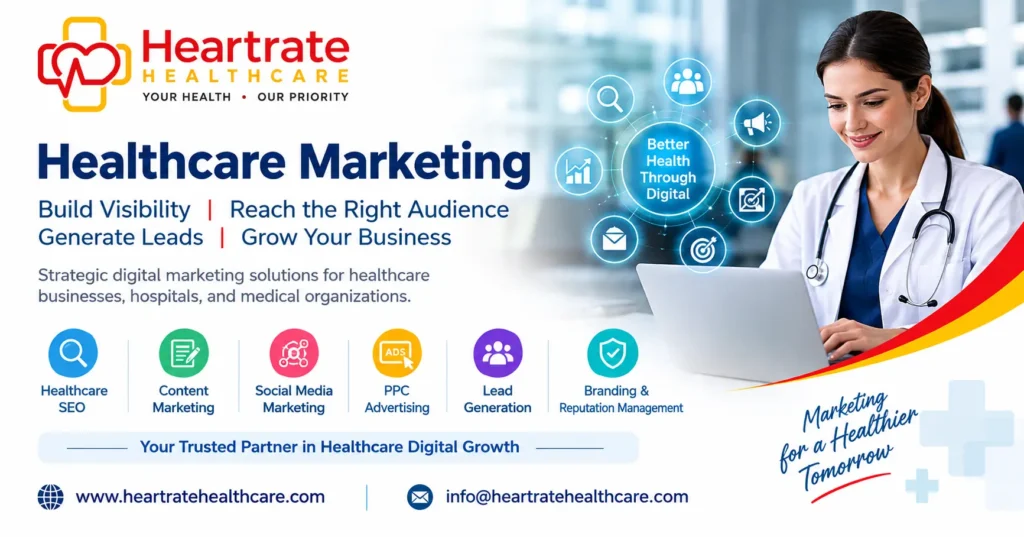
Healthcare Marketing refers to the strategic promotion of healthcare-related organizations, services, products, solutions, and businesses through online and offline channels. In the digital era, this can include search engine optimization, content creation, social media, paid advertising, email campaigns, website optimization, online reputation management, and lead generation.
Unlike general marketing, healthcare-focused campaigns require a strong emphasis on credibility and audience intent. People searching for healthcare-related information often want clear, trustworthy, and relevant information before taking action.
For B2B healthcare companies, the decision-making process can be even more complex. Hospitals, healthcare networks, medical organizations, technology providers, insurance-related businesses, and other enterprises may evaluate vendors based on expertise, service quality, reputation, technology, security, scalability, and experience.
A successful Healthcare Marketing program considers these different buyer journeys and develops content and campaigns that support prospects throughout the decision-making process.
Why Healthcare Marketing Is Important
Digital behavior has changed the way people interact with healthcare businesses. A potential customer may discover a company through Google, visit its website, read a blog article, check social media profiles, review services, and contact the organization after developing confidence in its capabilities.
This makes digital visibility an important part of business growth.
A strong Healthcare Marketing strategy can help organizations:
Increase brand awareness
Improve search engine visibility
Attract relevant website visitors
Generate qualified business inquiries
Build professional brand authority
Improve customer engagement
Support sales and business development
Communicate services more effectively
Strengthen online reputation
Develop long-term organic traffic
However, results depend on the quality of the strategy and execution. Publishing large quantities of content without understanding search intent, audience needs, or business goals may not generate meaningful results.
The objective should be to attract the right audience, not simply the largest possible audience.
Building a Strong Healthcare Marketing Strategy
A successful strategy starts with research. Before launching campaigns, businesses should identify their target audience, services, geographic markets, competitors, customer needs, and commercial objectives.
For example, a healthcare BPO company targeting hospitals in the United States will have very different marketing requirements from a local healthcare provider targeting patients in one city.
The first step in Healthcare Marketing should therefore be defining the audience.
Businesses can segment audiences according to:
Industry
Geographic location
Company size
Job role
Service requirements
Search behavior
Business objectives
Buying stage
Once the audience is understood, marketers can develop appropriate messaging and channel strategies.
Healthcare SEO and Organic Search
Search engine optimization is one of the most important components of modern digital marketing. Healthcare organizations need to ensure that their websites can be discovered when potential customers search for relevant services, solutions, and information.
Healthcare SEO focuses on improving website visibility for relevant search queries while providing useful content and a technically strong website experience.
A comprehensive Healthcare Marketing strategy should include:
Keyword research
Search intent analysis
On-page SEO
Technical SEO
Internal linking
Metadata optimization
Image optimization
Website speed improvement
Mobile optimization
Content development
Local SEO where applicable
Authority building
Keyword research should not focus only on high-volume terms. Long-tail keywords can sometimes provide more valuable traffic because they represent specific user needs.
For example, a business may target broad terms such as healthcare services while also targeting more specific commercial phrases related to healthcare outsourcing, healthcare BPO, healthcare RPO, medical back-office services, or healthcare technology support.
Healthcare Content Marketing
Content plays a major role in building authority and attracting organic traffic. A professional content strategy can include blog articles, service pages, case studies, industry guides, FAQs, white papers, reports, and educational resources.
The purpose of Healthcare Marketing content should be to answer genuine audience questions while demonstrating the organization’s knowledge and capabilities.
High-quality content should be:
Original
Accurate
Relevant
Well-structured
Easy to understand
Supported by reliable information
Written for a clearly defined audience
Aligned with search intent
Updated when necessary
For B2B healthcare organizations, content can also support the sales process. A detailed article about outsourcing challenges, for example, may help a prospective client understand a problem before contacting a service provider.
Instead of producing content only to satisfy search engines, businesses should create resources that are genuinely useful to readers.
Healthcare Social Media Marketing
Social media provides healthcare businesses with opportunities to build brand awareness and maintain ongoing communication with their audience.
Depending on the organization and target market, relevant platforms may include LinkedIn, Facebook, Instagram, YouTube, and other professional or community-based networks.
For B2B organizations, LinkedIn can be particularly valuable for professional networking, employer branding, thought leadership, company updates, and lead generation.
Social media content may include:
Company updates
Industry insights
Educational posts
Employee stories
Service highlights
Infographics
Videos
Blog promotions
Business milestones
Corporate announcements
A consistent social media presence can strengthen the overall Healthcare Marketing ecosystem by supporting website traffic, brand recognition, and audience engagement.
The objective should not be to post simply for the sake of activity. Every post should have a purpose, such as educating an audience, creating awareness, encouraging engagement, or supporting a business objective.
Healthcare PPC and Paid Advertising
Organic search can deliver sustainable traffic, but paid advertising can provide faster exposure when campaigns are carefully planned.
Healthcare PPC may include search advertising, display advertising, social media advertising, remarketing, and other paid digital channels.
Paid campaigns should begin with clearly defined goals. These goals could include:
Website traffic
Lead generation
Brand awareness
Service inquiries
Event registrations
Content downloads
Appointment-related actions where appropriate
A successful Healthcare Marketing campaign should monitor important performance metrics such as impressions, clicks, click-through rate, cost per click, conversion rate, cost per lead, and return on advertising spend.
Businesses should avoid evaluating campaigns based only on impressions or clicks. A campaign that receives many clicks but produces no qualified leads may not be delivering business value.
Healthcare Lead Generation
Lead generation is particularly important for B2B healthcare organizations. Generating traffic is useful, but converting qualified visitors into inquiries is what can create measurable business opportunities.
A strong lead-generation strategy can include:
Service landing pages
Contact forms
Consultation requests
Downloadable resources
Case studies
Lead magnets
Email campaigns
Search advertising
LinkedIn campaigns
Remarketing
Website landing pages should clearly communicate what the organization offers, who it serves, what differentiates it, and how visitors can take the next step.
The lead-generation process should also make it easy for prospects to contact the business.
Healthcare Branding and Online Reputation
Trust is an important factor in healthcare-related industries. A professional brand can help businesses communicate reliability, experience, consistency, and expertise.
Branding includes more than a logo. It encompasses website design, visual identity, tone of communication, messaging, content quality, social presence, customer experience, and reputation.
Online reputation management can also help organizations monitor how their company is represented across search engines, directories, social platforms, and other digital properties.
An effective Healthcare Marketing program should therefore ensure that branding and messaging remain consistent across channels.
Healthcare Email Marketing
Email remains a valuable communication channel for many healthcare businesses, particularly in B2B environments.
Email campaigns can be used to share:
Industry updates
Company news
Educational resources
Service information
Research-based content
Event announcements
New solutions
Newsletter content
The most effective email strategies focus on relevance rather than sending excessive messages. Audience segmentation can help organizations deliver more appropriate content to different groups.
For example, existing clients may receive service updates while prospects receive educational content related to their business challenges.
The Role of Website Optimization
A website is often the central component of a company’s digital presence. Every marketing channel may ultimately direct users toward the website.
Therefore, website performance is an important part of Healthcare Marketing.
A professional healthcare business website should provide:
-
Fast loading speeds
-
Mobile-friendly design
-
Clear navigation
-
Secure connections
-
Strong calls to action
-
Easy-to-read content
-
Proper metadata
-
Search-friendly structure
-
Accessible contact information
-
Clear service descriptions
Website speed is particularly important because users may leave slow websites before exploring the available services.
Images should be optimized, unnecessary scripts should be reduced, caching should be configured appropriately, and technical issues should be monitored regularly.
Data-Driven Healthcare Marketing
Marketing decisions should be based on measurable data whenever possible.
Analytics tools can help organizations understand:
-
Where visitors come from
-
Which pages receive traffic
-
Which keywords attract users
-
How users interact with content
-
Which campaigns generate leads
-
Which channels perform best
-
Where users leave the website
A data-driven Healthcare Marketing approach makes it easier to identify opportunities and improve underperforming campaigns.
For example, if a service page receives significant organic traffic but generates few inquiries, the business can investigate the page’s messaging, user experience, calls to action, and conversion process.
Similarly, if paid advertising produces expensive leads, targeting, messaging, keywords, landing pages, or bidding strategies may need improvement.
Local and Global Healthcare Marketing
Healthcare organizations can have very different geographic requirements.
A local healthcare business may focus on city-level visibility and local search. A global B2B organization may instead target specific countries, industries, and professional audiences.
International Healthcare Marketing requires consideration of:
-
Geographic targeting
-
Search behavior
-
Language
-
Cultural differences
-
Regional competition
-
Local search trends
-
Business expectations
-
Market-specific messaging
For companies targeting the United States, for example, campaigns should be designed around the terminology, search behavior, professional expectations, and business environment of the U.S. healthcare market.
Healthcare B2B Marketing
B2B healthcare marketing is focused on reaching organizations and decision-makers rather than individual consumers.
Potential audiences may include:
-
Hospitals
-
Healthcare organizations
-
Medical groups
-
Healthcare technology companies
-
Insurance organizations
-
Pharmaceutical businesses
-
Healthcare startups
-
Healthcare service providers
-
Clinics and healthcare networks
B2B purchasing decisions can involve multiple stakeholders. Marketing content should therefore address both business and operational concerns.
For example, a healthcare outsourcing company may need to communicate its capabilities related to scalability, workflow efficiency, data handling, staffing, technology, quality control, and customer support.
This is where a specialized Healthcare Marketing strategy can help connect business solutions with specific organizational needs.
Building Authority Through Thought Leadership
Thought leadership can help organizations differentiate themselves in competitive markets.
Companies can demonstrate expertise through:
-
Industry articles
-
Expert commentary
-
Research-based content
-
Educational guides
-
Webinars
-
Case studies
-
Industry reports
-
Professional presentations
The goal is not simply to describe services but to demonstrate knowledge of the problems that customers face.
For Heartrate Healthcare (HRHC), a strong thought-leadership approach can help communicate expertise across healthcare BPO, healthcare support, outsourcing, staffing, technology support, and related business services.
E-E-A-T and Healthcare Content
Search engines increasingly emphasize content quality and trustworthiness, particularly for topics that can influence people’s health, safety, or important decisions.
Healthcare-related businesses should therefore pay close attention to content quality.
An effective content strategy should demonstrate experience, expertise, authority, and trustworthiness where appropriate.
Businesses should avoid unsupported claims, misleading statements, exaggerated promises, or content that could create confusion.
For service companies, transparency about capabilities, processes, experience, and business operations can contribute to a stronger online presence.
Measuring Healthcare Marketing Performance
Successful marketing requires continuous measurement and optimization.
Important metrics can include:
-
Organic traffic
-
Keyword rankings
-
Impressions
-
Click-through rate
-
Conversion rate
-
Qualified leads
-
Cost per lead
-
Website engagement
-
Bounce or engagement metrics
-
Email performance
-
Social engagement
-
Advertising return
Not every organization needs to prioritize the same metrics. KPIs should be connected to business objectives.
For example, an established B2B organization may prioritize qualified leads and pipeline contribution rather than simply increasing website sessions.
A practical Healthcare Marketing reporting system should connect marketing activity with measurable business outcomes.
Common Healthcare Marketing Mistakes
Many businesses make avoidable mistakes when developing digital campaigns.
Common problems include:
1. Focusing Only on Keywords
Keywords are important, but content should satisfy search intent and provide genuine value.
2. Publishing Without a Strategy
Random blog publishing rarely creates a sustainable growth system. Content should be connected to audience needs and business objectives.
3. Ignoring Technical SEO
Poor website speed, broken links, indexing problems, duplicate pages, and weak site architecture can limit organic performance.
4. Measuring Vanity Metrics
Large traffic numbers do not necessarily mean successful marketing. Qualified conversions are often more meaningful.
5. Inconsistent Branding
Different messaging across platforms can weaken brand recognition and trust.
6. Neglecting Mobile Users
A significant portion of internet traffic comes from mobile devices, making responsive design essential.
7. Using Generic Content
Healthcare audiences often have specialized needs. Content should be developed for clearly defined segments.
How Heartrate Healthcare Supports Healthcare Marketing
Heartrate Healthcare (HRHC) is positioned as a business-to-business organization providing healthcare-focused BPO, RPO, staffing, IT support, and related business solutions.
For healthcare organizations and enterprises seeking to strengthen their digital presence, a coordinated marketing approach can help connect business services with relevant audiences.
At Heartrate Healthcare, the approach to Healthcare Marketing can be aligned with broader business objectives, including brand visibility, online presence, audience engagement, lead generation, and long-term digital growth.
A complete strategy may combine SEO, content development, social media, website optimization, paid advertising, analytics, and conversion-focused improvements.
The most effective approach is not necessarily to use every available channel. Instead, organizations should identify where their target audience spends time and invest resources into channels capable of producing meaningful results.
Future Trends in Healthcare Marketing
The digital healthcare environment continues to evolve. Artificial intelligence, automation, personalization, video content, voice search, analytics, and changing search engine technologies are influencing how organizations communicate with audiences.
Businesses should monitor these developments while maintaining a strong focus on fundamentals.
The future of Healthcare Marketing is likely to place even greater emphasis on:
-
High-quality original content
-
Personalization
-
Data-driven decision-making
-
Search visibility
-
Video communication
-
Automation
-
Customer experience
-
Brand trust
-
Omnichannel marketing
-
Conversion optimization
Technology can improve marketing efficiency, but it should support—not replace—human understanding, strategic thinking, quality control, and responsible communication.
Conclusion
A strong digital presence can provide healthcare businesses with opportunities to reach new audiences, communicate their expertise, generate qualified leads, and build long-term brand value. However, sustainable growth requires more than individual campaigns.
Effective Healthcare Marketing combines strategy, search optimization, content, social media, paid advertising, branding, website performance, analytics, and continuous improvement.
Businesses should begin by understanding their target audience and defining measurable goals. From there, they can develop content and campaigns that address genuine customer needs while communicating their unique value proposition.
For healthcare B2B organizations, trust and credibility should remain at the center of every marketing activity. Professional content, transparent communication, consistent branding, strong website experiences, and data-driven optimization can create a foundation for sustainable digital growth.
Heartrate Healthcare (HRHC) understands the importance of combining healthcare industry knowledge with modern digital strategies. By taking a structured approach to Healthcare Marketing, organizations can improve their online visibility, reach relevant decision-makers, strengthen their brand presence, and create opportunities for long-term business growth.
The ultimate objective is not simply to be visible online. It is to become visible to the right audience, communicate the right message, build trust, and turn digital attention into meaningful business opportunities.